What is the website worth as a business?
Online businesses are priced as a multiple of monthly net profit. The tool detects the business model, applies the multiples buyers pay on marketplaces, and shows exactly what moves the price.
The multiple depends on the model.
The bands follow published marketplace data. Where a website is only the sales channel of a service business, it is not sold on its own and the tool says so instead of inventing a price.
- Software as a service35× to 60×
- Content and affiliate site25× to 40×
- Publisher with display ads28× to 45×
- Online shop25× to 40×
- Digital products and courses25× to 40×
- Marketplace or platform30× to 50×
- Times average monthly net profit of the last 12 months. Axis from 20× to 60×.
Try it with your figures.
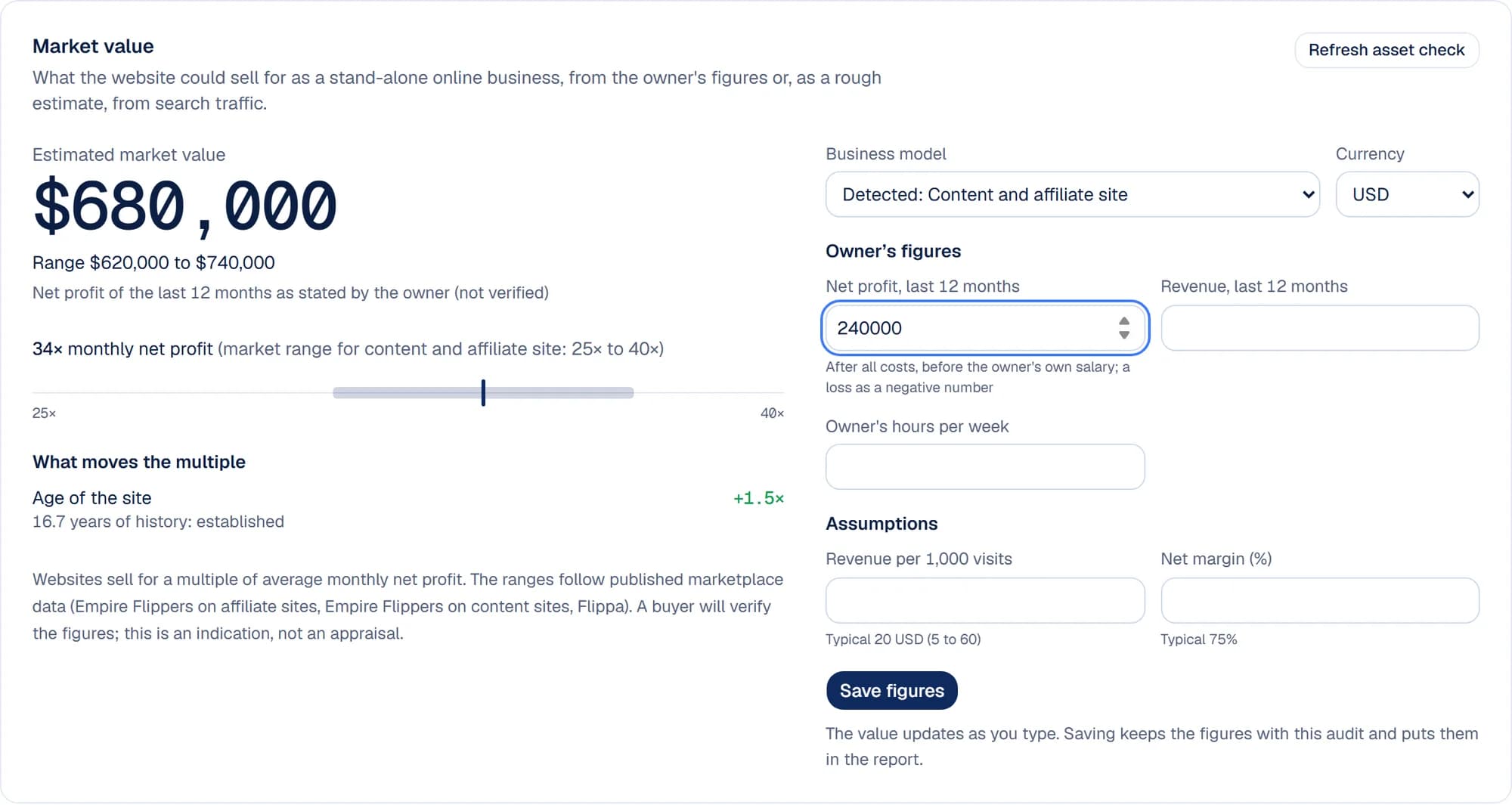
The same arithmetic the app uses. Change the model, the profit, the age and how much the owner still works, and watch the multiple move.
Estimated market value
$670,000
Range $610,000 to $730,000
33.5× monthly net profit (market range 25× to 40×)
25×40×
- 6 years of history: established+0.8×
- 10 hours per weekno effect
An indication from the owner’s figures, not an appraisal. In the app the multiple also reflects the scan: traffic trend, Google update losses, concentration, partner dependence and due-diligence flags.
What moves the multiple.
Inside the band, the position follows what the scan found. Each factor is shown with its effect, so a buyer and a seller can argue about facts.
- Age of the siteA long, verifiable history raises the multiple; a site under a year old lowers it.
- Traffic trendEstimated organic traffic year on year. Growth adds, a fall of 30% or more costs the most.
- Google update lossesEach sharp drop in a Google update month lowers the multiple.
- Traffic concentrationWhen one page carries more than half of the search traffic, the risk is priced in.
- Diversified incomeTwo or more visible revenue streams add a little.
- Dependence on one partnerMore than 80% of affiliate links to one network lowers the multiple.
- Owner workloadClose to passive adds; a buyer taking over a full-time job pays less.
- Website qualityA Business Impact Score of 75 or more adds; below 50 it costs.
- Due-diligence flagsEvery high-risk finding a buyer would discount lowers the multiple.
- Customer ratingsA public rating below 3.5 of 5 costs a little.
The checks a buyer makes before paying.
The asset check runs from outside, as any visitor would see the site. Every line says what it rests on; a line marked n/a was not checked, which is different from clean.
For buyers and sellers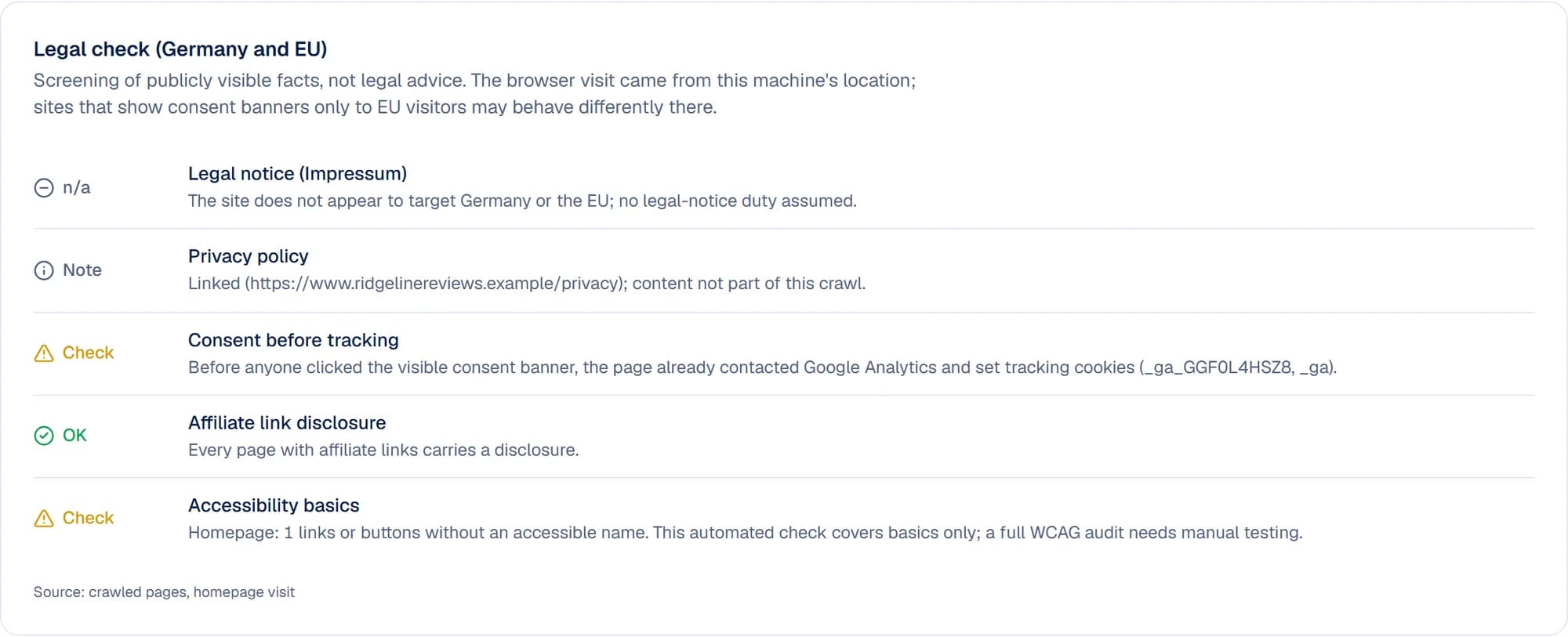
- Revenue modelHow the site earns money as far as it is visible from outside: affiliate programmes, ads, shop, subscriptions, with link counts per programme.
- Search trafficEstimated organic visits, the trend year on year, ranking keywords, referring domains and losses in Google updates.
- Domain historyRegistration date, registrar, expiry and the web archive record, so the age of the business is a fact, not a claim.
- Technology and running costsPlatform, visible paid tools, maintenance effort and what a buyer actually receives at handover.
- Legal check (Germany and EU)Imprint, privacy policy, consent before tracking, affiliate disclosure and accessibility basics, as publicly visible facts.
- Security hygieneCertificate, HTTPS redirect, HSTS, content security policy, cookie flags and security.txt, checked from outside only.
- Visibility in AI assistantsWhether AI crawlers may read the site, llms.txt, structured data, and whether assistants know the brand.
- ReviewsPublic ratings on Trustpilot and the Google Business Profile, where they can be read.
Know the value before the conversation.
Run a quick check with the market value, then the full audit with search data before you buy or sell.