How the score is made, and why you can check it.
A real browser, an industry framework, eleven weighted modules and evidence that is verified against the page. Here is what happens between the domain and the report.

Six rules the audit follows.
Read only
The audit opens pages the way a visitor does. Forms are inspected, never submitted; nothing is bought or booked. Private and internal network addresses are never visited.
Evidence or it does not count
Every finding points to the page and the exact words it is about. The quote is checked against the page text; a finding whose evidence cannot be verified is dropped.
Judged against the industry
The audit detects the business and applies the matching framework: what buyers in that market need to see and how much each module weighs.
Confidence is part of the score
Each module and the overall score carry a confidence. Where a stage could not run, the audit says so instead of guessing.
People decide
The tool proposes. Your team approves, edits or rejects every finding, and only approved findings reach a client report.
Kept unchanged
Every audit run is stored as it was, so a later scan can be compared with it line by line.
From pages to a score.
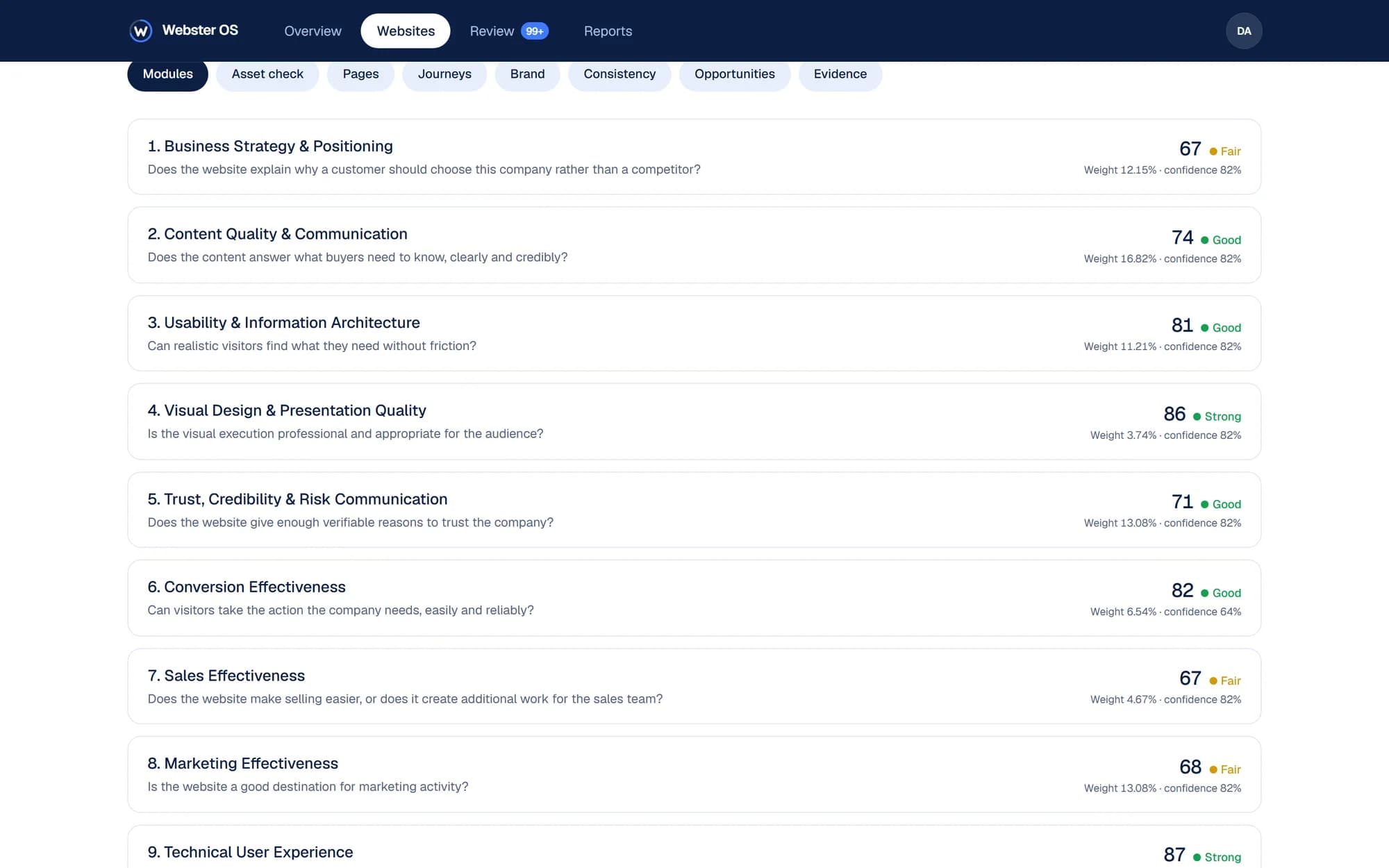
Each module is scored from 0 to 100 against its criteria, minus capped penalties for verified high-impact issues. The Business Impact Score is the weighted mean of the modules, with weights set by the industry framework. A critical business failure caps it, so a disaster cannot hide behind good averages.
- 85 to 100
- Strong
- 70 to 84
- Good
- 55 to 69
- Fair
- 35 to 54
- Weak
- Below 35
- Critical
- 1Business Strategy & PositioningDoes the website explain why a customer should choose this company rather than a competitor?
- 2Content Quality & CommunicationDoes the content answer what buyers need to know, clearly and credibly?
- 3Usability & Information ArchitectureCan realistic visitors find what they need without friction?
- 4Visual Design & Presentation QualityIs the visual execution professional and appropriate for the audience?
- 5Trust, Credibility & Risk CommunicationDoes the website give enough verifiable reasons to trust the company?
- 6Conversion EffectivenessCan visitors take the action the company needs, easily and reliably?
- 7Sales EffectivenessDoes the website make selling easier, or does it create additional work for the sales team?
- 8Marketing EffectivenessIs the website a good destination for marketing activity?
- 9Technical User ExperienceDo technical problems interfere with visitors completing commercial actions?
- 10Content Consistency & Cross-Page IntelligenceDo business-critical statements agree across the website?
- 11Brand Identity, Brand Language & Corporate CommunicationDoes the website communicate a recognizable, credible and consistent brand that supports the company's positioning?
Where the data comes from.
- The website itselfUp to 120 pages read, the key pages rendered on desktop and mobile in a real browser, journeys followed through the site's own navigation.
- AI judgment, checkedA language model reads the pages and drafts findings; quotes are verified against the page text before a finding counts.
- Search and backlink dataTraffic estimates, rankings, backlinks, reviews and AI mentions from DataForSEO on the plans with search data.
- Public registersDomain registration from the RDAP registry, history from the web archive, ratings from public review pages.
See what your website is really doing.
Start with a free quick check. No card, no call, about three minutes.